
About
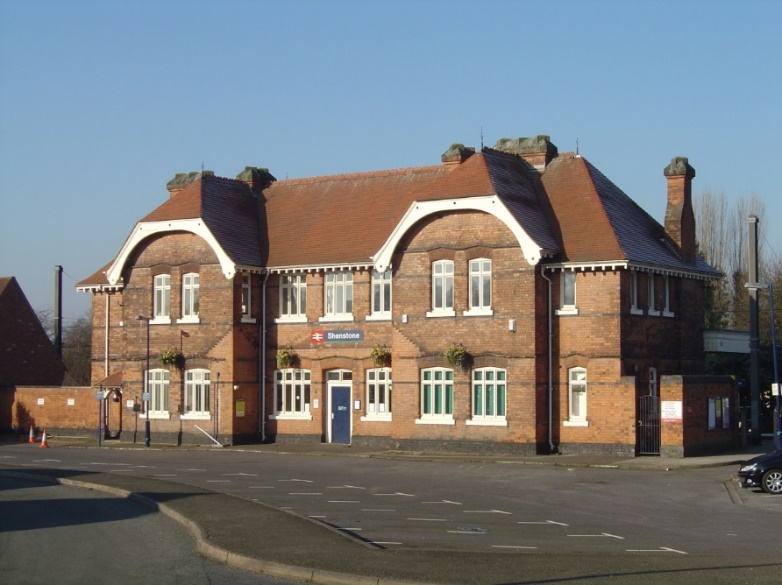
Shenstone Station opened in December 1884. Up until that time the journey from Birmingham via Sutton Coldfield to Lichfield took around two and a half hours by horse-drawn carriage. The train journey took 40 minutes. Shenstone station was designated as the principal, intermediate station, and in 1884 was the headquarters of the resident engineer, George Dawson. The fare from Birmingham to Lichfield was 3s 9d return with four trains a day. Shenstone Station has a large carpark, originally this was designed so that horse-drawn carriages could drive in and out safely. In 1954 Shenstone Station was awarded Best Kept Station. There were two classes, cleanliness and tidiness, and the best kept gardens. Shenstone was awarded first prize in each category. It also equally successful in 1955.
In 2020 the station was “adopted” by a small group of keen villagers to re-ignite the beauty of the gardens and to maintain the integrity of the beautiful building. Our adoption group has purchased planters for the front of the building and platforms. We keep them planted and maintained to make the station a pleasant place to be. We bought noticeboards to inform passengers of our group activities, events in the community and heritage trails around the village. We commissioned https://www.annatomix.com a local street artist, to create the beautiful Kingfisher which adorns a quiet area on Platform 2. Our adoption group planted over 2000 spring bulbs on the bank above the car-park and along platform 1.
In 2024 we celebrated our station’s 140th Birthday. The station ticket office was open and there was an unveiling of a display to celebrate the last 140 years of the station and the village of Shenstone; its people, families and business.
Paula’s History Snippets
Shenstone Railway Station
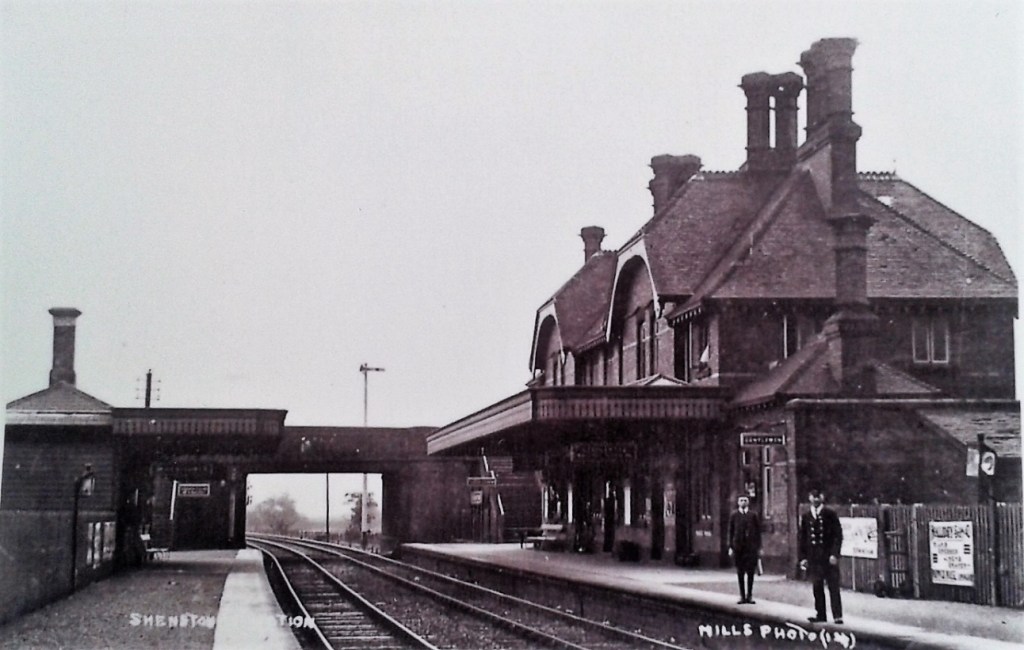
This is a picture of Shenstone Railway Station from an old postcard. This romantic image shows the station as it was in its heyday, complete with wonderful decorated brick, chimney stacks, glass canopy, gates, pony traps, Victorian gas lamps and a lovely wrought iron foot-bridge across the track.
The Station Master and his family lived on the upper floor.

Shenstone Railway Station was opened in 1884, when the London and North Western Railway Co extended the Birmingham to Sutton Coldfield line northwards to Lichfield. The expanse of Shenstone Moss estate which once extended beyond Footherley was interrupted in that year by the extension of the railway line. London & North Western Railway Co purchased the land on 24th February 1882 and the track passed through the Shenstone Moss estate then owned by Thomas Bagnall.
There is some evidence that the station building was funded by Thomas Bagnall and his sons. The fact that the station was the principal station on the line between Sutton Coldfield and Lichfield suggests that there was some involvement with the landowners. Firstly, in documents held by National Archives listing the properties for the sale of Shenstone Court, Shenstone Station is on the list.
Deeds show that the whole estate was passed from Thomas Bagnall and his sons to Richard Cooper when he purchased the Moss, later named Shenstone Court. The Bagnalls were heavily involved in manufacturing iron and many of the rails used on the railway systems here and around the world used their iron. They therefore would have had some influence with railway companies. Secondly, while Shenstone Station was being constructed, a lodge at the entrance to Court Drive from Footherley Road was built and named Station Lodge. It too was erected in the Victorian Gothic style of Shenstone Station with large decorative brick chimney stacks. Presumably, the lodge was built when Court Drive was opened up to give the Bagnall family, who lived at the Moss at that time a more straightforward route to the station than the original route via Birmingham Road.
The coming of the railway brought much employment to Shenstone, including a station master, guards, porters, drivers, wheel-tappers, platelayers, shunters, signalmen, and clerical staff. Photographs of the station around the turn of the century show that even the waiting rooms had chimneys allowing passengers to wait in warmth and comfort on cold days.
People who use the line today will have experienced how cold that wait can be without proper shelter.
A report in the Lichfield Mercury dated 13th June 1884 gives details of the new railway route from Sutton Coldfield to Lichfield. It highlights the benefit of reducing time of travel between the two places and states that:
“It may also be expected that by tapping the country lying between Sutton Coldfield and Lichfield not only will there be developed agricultural and ordinary local traffic but the beauty of the country and advantages of ready communication with Birmingham will lead to an extension considerably beyond Sutton of that system of villa residences which has sprung up all along the line as far as the present terminus.”
It goes on to say that “The delights of Sutton Park will be more accessible to visitors from Lichfield, while at one of the stations close to Four Oaks Park (a noted racecourse), the owners will make new entrances to the Park.”
This is the reason Four Oaks Station has such a large car park as the area was once meant for racegoers from all over the country, including their horses.
It continues “Shenstone will be the principal intermediate station and at present forms the head-quarters of the resident engineer, George Dawson of Ivy House using the old schoolroom as a drawing office. In this neighbourhood, most expensive works have been necessary on account of the boggy nature of the ground and its ability to floods. At some points the peat has been dug out to the extent of 6 feet and dry material substituted in order to secure a firm footing for the embankments. An immense number of flood-arches have also been constructed, the set at the Shenstone Station comprising 13 and forming quite a viaduct. The stream which principally causes the demand for all this trouble is the Black Brook, a tributary of the Tame. Numerous culverts have had to be constructed under the embankments and several land drains diverted; and the bridges over this portion of the line have been built of unusual strength, some of them containing over 2000 ft of brickwork. The most troublesome portion of the ground was found between Shenstone Woodend and the point where the line crosses the line of the Old Roman Road, Watling Street.
The NWRC in view of and to aid in the future development of the neighbourhood have made an excellent approach to their station having practically constructed a new road to it. The lane which it has supplanted was at times under water, but the new road is carried for some distance on an embankment and crosses the line on a viaduct already mentioned.
The average number of men employed on these works, including to Lichfield has been over 500 and they have worked under the personal supervision of Mr Evans and the engineer.
The Shenstone Station buildings will be of brick in the Gothic style and there will be ample accommodation for the conveyance of horses and carriages. A large goods shed has already been built and a coal-yard is being laid down. The passenger station will have a glass roofed portico and the platforms will be covered.
Before the Second World War, the Tar Works and the A.I.D. (Air Industrial Developments) factory were on the site now known as Admiral Parker Drive, their proximity to the railway would not have been a coincidence. Opposite were the sidings and the shunting engine shed.
Farmers used the line too in those days, to get their cattle to market. Keith Watton in his book “A Contemporary History of Shenstone” shared childhood memories of this area in the 1930s.
“I can remember the farmers herding their cattle through the village. The cattle were kept in pens while they were waiting to be transported to market. We used to go down to the sidings to watch the little engine shunting the carriages, where they put the animals, so many to each truck. The shunter had a big pole to lift the chains onto hooks between the trucks to connect the carriages to one another”.
Jean Garbett, another long-time resident of Shenstone, remembers watching her father, who worked at Saxton’s Farm in Ashcroft Lane, drive young bullocks (that had been transported from market to Shenstone by train) over the bridge and along Lynn Lane into Ashcroft Lane to the farm. Not an easy task to keep them all going in the right direction.
Station Master Beswick and his family lived on the upper floor of the station from the late 1940s to 1959.
Stationmasters at Shenstone Station
J. W. Patterson to 17th April 1904 (UK Railway employment records)
William Cotterill to 22nd April 1907 there 1905 (UK railway employment records)
Arthur Abbott to 3rd December 1909
George E Howlett there for 1911 census. Left 1921
Robert Tate McKenzie there 1945
J A Beswick there to 1959. (Received best kept station award in the 1950s)
Robert Henry Watson there from 1959 until the 1960s, he also looked after Blake Street Station. He lived at 48, Court Drive. Previously he was Stationmaster at Hammerwich. His wife died in a fire at his Court Drive address.
William Tittley from abt.1982 to date retired 1989. He was Station Master for seven years.
Stonnall History Group
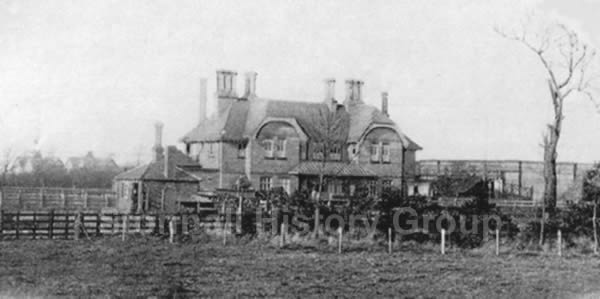
The above photograph was taken around 1917, note the lack of buildings nearby. Houses on Ashcroft Lane can be seen in the distance.
Four cottages were built nearby for the railway staff, now called Station Close, then called Railway Cottages. The residents in 1911 were: –
Arthur Hackett, 51, Railway platelayer, wife Alice and 7 children.
Robert Dawkes, 39, porter, wife Clara and 6 children.
William Milner, 43, platelayer, wife Annie and 6 children.
Jacob Perkins, 31, platelayer, wife Florence and 1 daughter.
Imagine eight adults and twenty children living in such close proximity, although this was probably not unusual at the turn of the century with large families being the norm.
At the other end of the social scale, Sir Richard and Lady Cooper who lived at Shenstone Court, had the honour of entertaining King George V at Shenstone Court on 23rd July 1915. The King was continuing his inspection of factories in Birmingham to witness the production of war material and to support and encourage the workers. He spent the night at Shenstone Court and the Royal Train spent the night in the sidings at Shenstone Station.
In 1951, Shenstone Station won an award for the Best Kept Station for the second year running. Mr J Beswick, Station Master and his staff were congratulated for winning first prize in the western district of the London Midland Region, Birmingham when over 50 Stations entered. A correspondent wrote “Great credit is due to the staff of Shenstone Station for their all-year-round efforts to maintain a first class standard.”
Stationmaster Robert Watson who took over from Stationmaster Beswick had a hard act to follow.
The route from New Street, Birmingham to Sutton Coldfield and Lichfield had a well-used regular suburban service, which was switched from steam to diesel multiple unit operation in 1956, leading to an even larger increase in passengers using the line.
However, the station was closed to goods in 1964 around the time of the notorious “Beeching Cuts”.
1st Shenstone Scout troop on Sunday Parade, 1962, showing a Shenstone Station before some features were removed. Picture kindly supplied by Steve Hickman, from Brownhillsbob’s Blog.
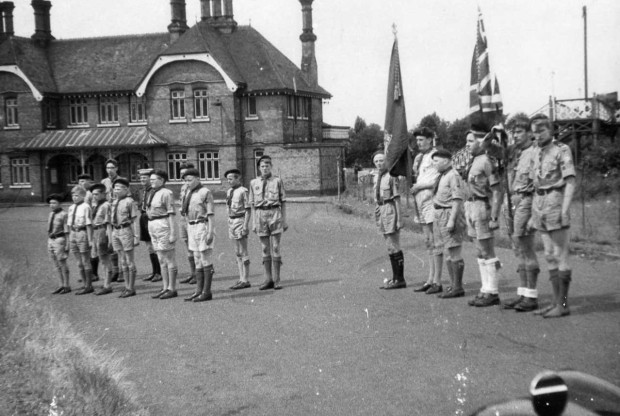
This photograph was taken in 1962, still with chimneys, glass canopy and bridge across the track.
The chimneys were removed in the 1970’s when British Rail sold the station building and the new owners converted the upper floor into offices.
By the late-1980’s, the elderly diesels operating the service were becoming increasingly unreliable and during the early 1990’s the line was electrified and a new fleet of Class 323 Electric Multiple Units were introduced to work the electrified line, and replace the elderly diesels. To facilitate the electrification, all road bridges were rebuilt or altered. It was then that the ornate footbridge at Shenstone Station was removed to allow for the overhead line and steps up to the Lynn Lane bridge on the Lichfield bound platform were constructed.
By the 1990’s, the station ticket office and waiting room were less frequently open to the public, usually just mornings from 7am to 10am at commuter and school travelling times. A ticket machine was installed to be used outside those times.
The upper floor of the station is now used as offices and unlike many British stations the original, red-bricked station has survived all these changes and still exists today to greet passengers departing and arriving in Shenstone and even without its wonderful chimneys it is still a rather handsome building.
Best Kept Station
I met with a villager this morning, Mick Clews, whose dad worked for British Railways on the Spaghetti Line from when he left the army after the war until he retired in the 70’s(?) He worked as a guard and porter along the line.
The BR employee was called Albert Clews. The photo of the three men with a shield is “Best Kept Station” which Shenstone won several times.
The insignia on the hat of the gentleman on the left is interesting, Mick didn’t know who he was but we guessed he was important to be part of the photocall. The chap in the middle was Shenstone’s station master – Michael Beswick

Photos: the two men with the poles were working at the shunting yard at Shenstone. The poles were to manoeuver the carriages or trucks if they weren’t coupled correctly.
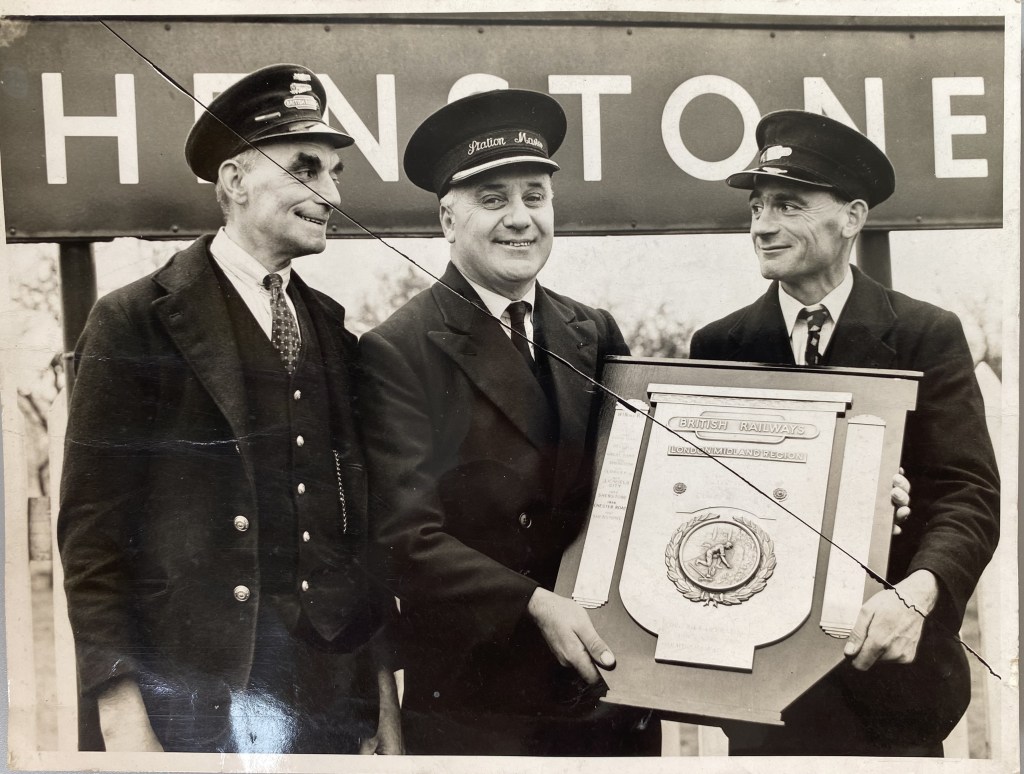

The presentation of the shield
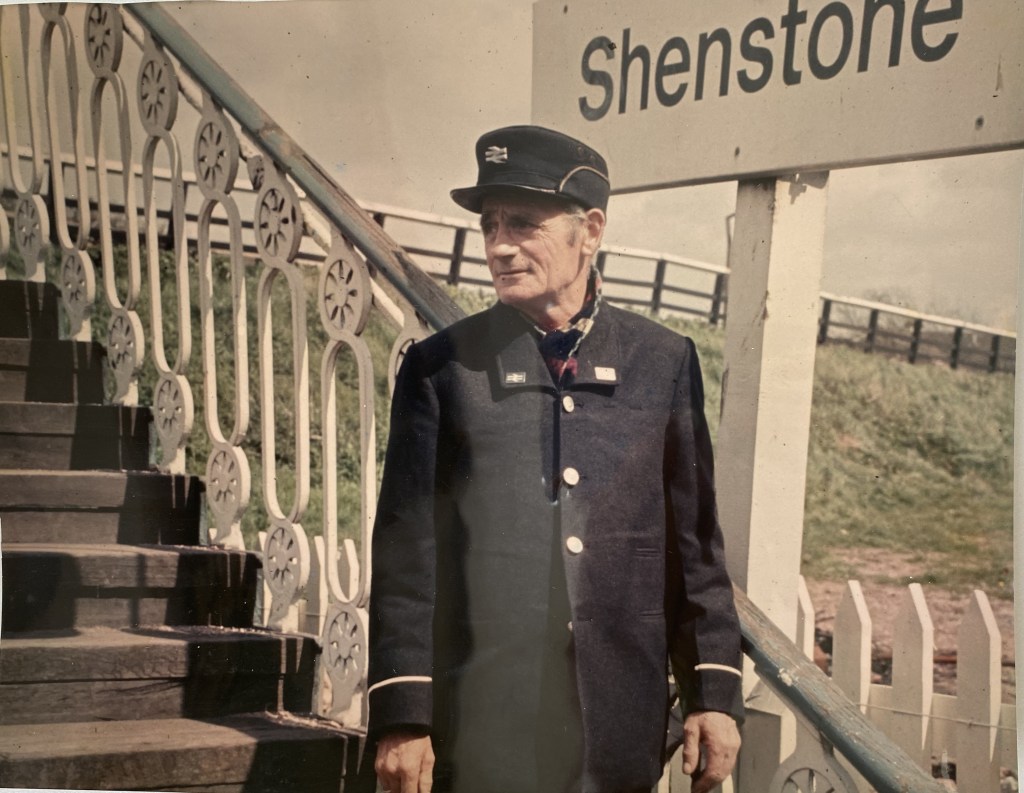
Albert Clews standing on the pedestrian bridge over the tracks – obviously before electrification
Car P Art Installation September 2025
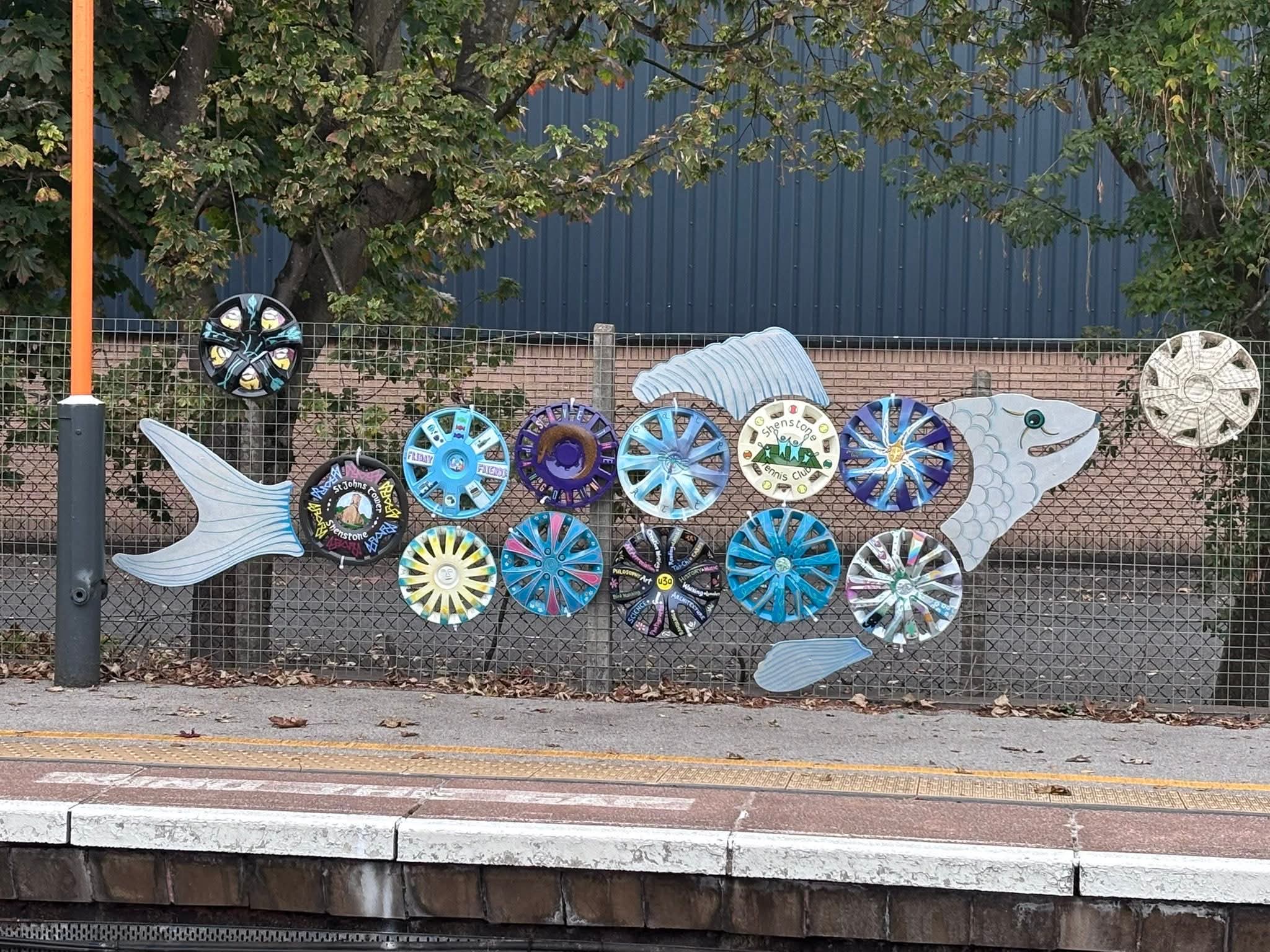
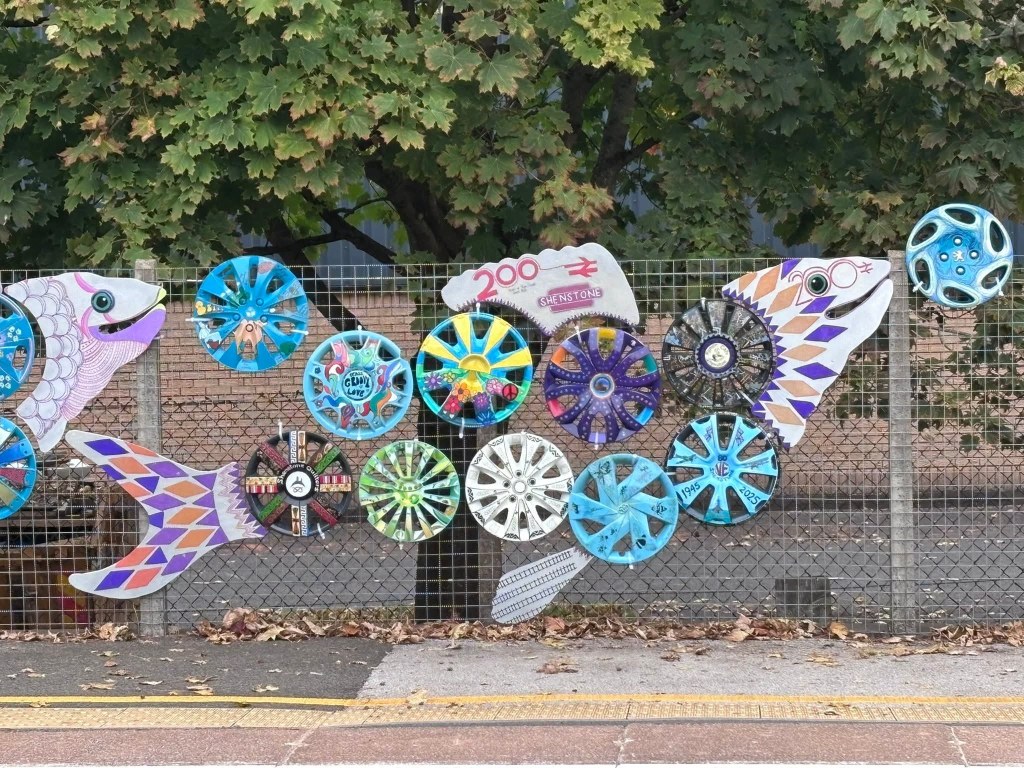
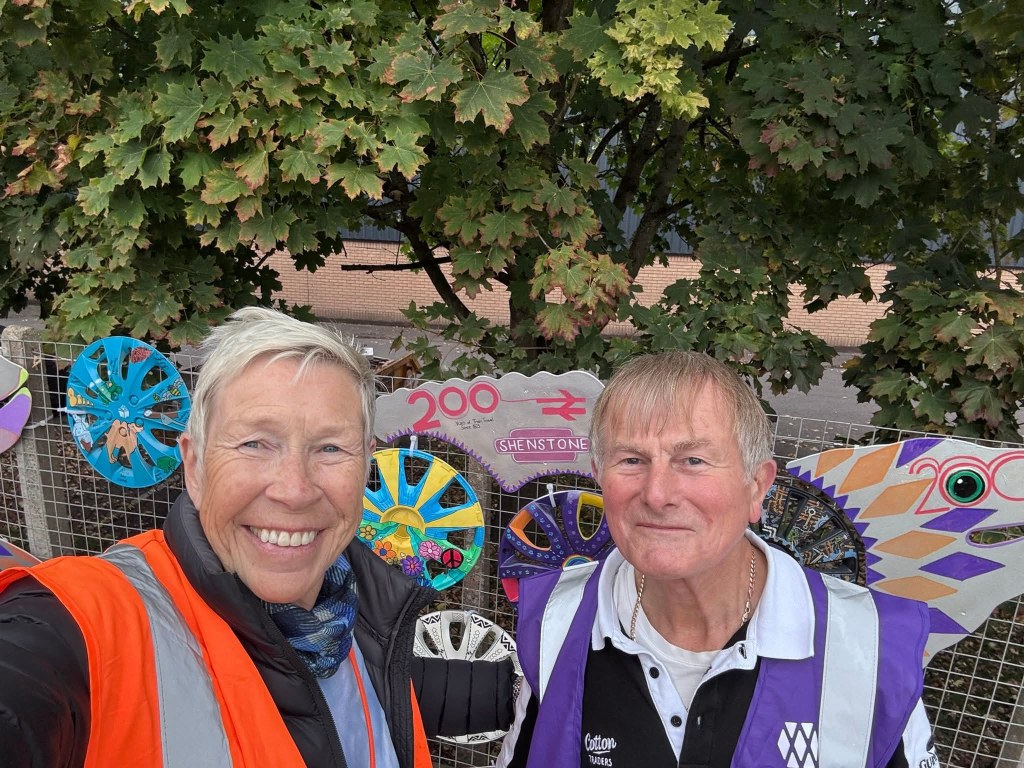
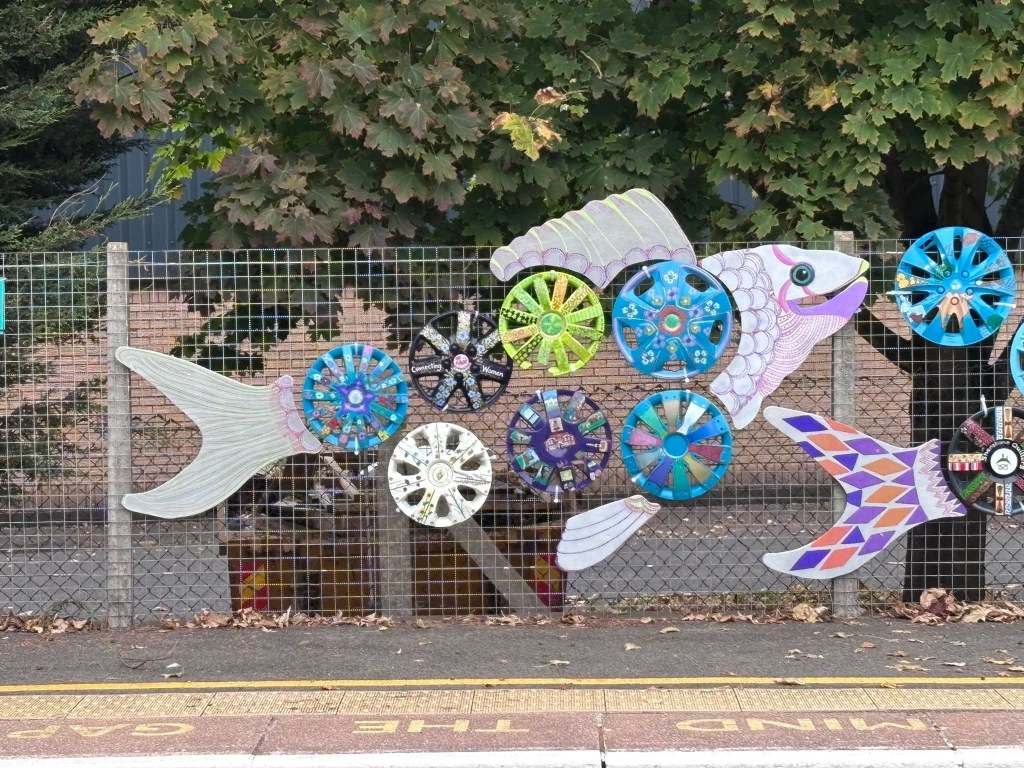
More volunteers would be warmly welcomed by our small but beautifully formed group. Follow us on Facebook or Instagram.

 THE SPAGHETTI LINE
